Google Tasks Offline: How to Keep Working Without Internet

Your internet goes down right before a deadline. If you rely on Google Tasks, that moment raises an immediate question: can you still see your tasks, check things off, and add new items?
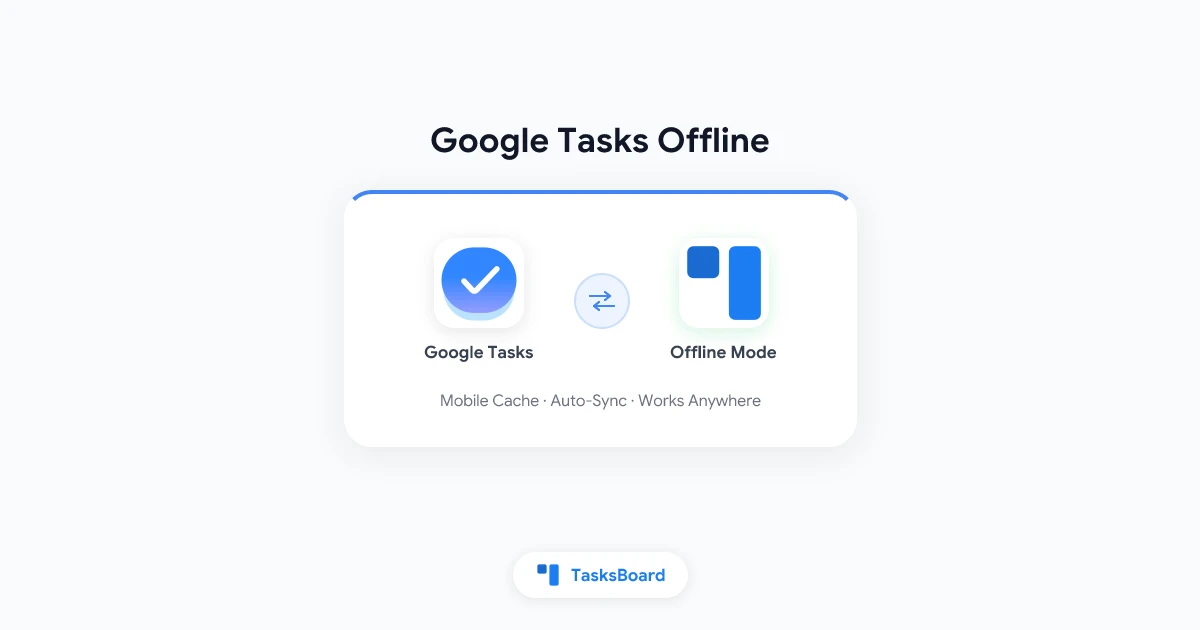
The short answer is yes, with important caveats. Google Tasks has built-in offline support on mobile, but the experience differs between platforms, and teams sharing lists through TasksBoard need to understand what the sync model looks like before an outage hits.
Key takeaways:
- Mobile apps cache tasks locally: The Google Tasks app on Android and iOS keeps a local copy that you can read and edit without a connection.
- Desktop web requires a connection: tasks.google.com does not support offline editing in most browser setups.
- Changes sync on reconnection: edits made offline queue up and sync automatically once your device goes back online.
- Conflicts are rare but possible: if the same task is edited from two devices while one is offline, the last write wins.
How Google Tasks handles offline access on mobile
Google Tasks for Android and iOS is a native app, not just a wrapper around the web version. That distinction matters for offline use.
When you open the app with a connection, it pulls a fresh snapshot of your lists and caches them on the device. That cache persists across app restarts. If you then lose connectivity, you can still:
- View all your lists and tasks
- Check off completed tasks
- Edit task titles and notes
- Add new tasks to existing lists
- Reorder tasks within a list
What you cannot do offline:
- Create a brand-new list (list creation requires the server to assign an ID)
- See tasks added by other people since your last sync
- Delete a list entirely
The sync queue is invisible. When connectivity returns, the app pushes pending changes to Google’s servers in the background. You do not need to tap a “sync now” button.
- Open the app at least once on a connection to populate the cache
- Keep background app refresh enabled so the cache stays fresh
- Do not force-close the app right before going offline
- Reconnect before your next sync window if you edit shared lists
Google Tasks on desktop: the offline gap
The web app at tasks.google.com does not have a service worker that enables offline editing. If you lose your connection while using Google Tasks in a browser, the page will show an error or stop responding to edits.
Some users access Google Tasks through the Gmail sidebar or Google Calendar. Both of those surfaces also depend on an active network connection.
Practical workarounds for desktop users:
- Keep the mobile app as a fallback for offline access
- Use Google Keep for notes that need to survive disconnection on desktop (Keep has offline support via Progressive Web App)
- Sync critical task lists to a simple text file if you regularly work in environments with unreliable internet
If offline desktop access is a hard requirement, this is one area where dedicated task managers with proper PWA support have an edge over Google Tasks today.
Shared lists and offline sync: what changes for teams
When multiple people share a Google Tasks list through TasksBoard, offline edits from individual team members follow the same mobile-sync model. Each person’s app queues their changes locally and uploads on reconnection.
The key risk is a write conflict on the same task. Scenario:
- Alice opens a task on her phone before boarding a flight.
- Bob edits the same task title from his desktop.
- Alice lands, her phone reconnects, and her local edit syncs.
Google Tasks resolves this with last-write-wins. Alice’s version will overwrite Bob’s if her sync timestamp is later. This is uncommon in practice, but teams with real-time collaboration needs should be aware of it.
For most teams, the sync window is short enough that conflicts never happen. The bigger concern is simply communicating offline status to teammates so they know not to expect immediate responses on shared boards.
Preparing your Google Tasks for offline use
A few habits reduce the chance of a bad offline experience.
Open the app before going offline. The cache is most accurate immediately after a fresh sync. If you know you will be on a plane or in a coverage-dead zone, open the Google Tasks app on your phone a few minutes before you lose signal.
Keep task lists reasonably sized. Very large lists with hundreds of tasks take longer to sync and are more prone to partial loads. Breaking work into smaller lists improves both performance and offline reliability.
Use task notes for context. Notes sync alongside the task title, so any detail you might need offline should live in the note field, not in an external doc that requires a connection to access.
Set due dates before going offline. You cannot add or edit due dates that trigger Calendar events when offline. Set them while connected.
Avoid creating new lists offline. Stick to editing within existing lists. Creating a new list may appear to succeed offline but fail silently or create a duplicate on sync.
Offline access on Google Tasks vs other apps
| Feature | Google Tasks (mobile) | Google Tasks (desktop) | Todoist | TickTick |
|---|---|---|---|---|
| View tasks offline | Yes | No | Yes | Yes |
| Edit tasks offline | Yes | No | Yes | Yes |
| Create new lists offline | No | No | Yes | Yes |
| Auto-sync on reconnect | Yes | N/A | Yes | Yes |
| Conflict resolution | Last-write-wins | N/A | Last-write-wins | Last-write-wins |
Google Tasks performs well on mobile against competing apps. The gap is the desktop web experience, which lacks offline support entirely.
How TasksBoard fits into offline scenarios
TasksBoard is a kanban board and list view built on top of Google Tasks. Because it reads from and writes to your Google Tasks data, it follows the same sync model.
When you use TasksBoard on mobile through a browser or add it as a PWA, it benefits from the Google Tasks mobile sync described above. On desktop, TasksBoard requires a connection for the same reason the underlying Google Tasks web app does.
The practical workflow for teams with intermittent connectivity:
- Use the Google Tasks mobile app as your offline inbox for urgent edits.
- Review and reorganize the board in TasksBoard when back online.
- Keep a lightweight task list for “offline-capable” items that you need to access without a connection.
For more on using Google Tasks reminders and due dates effectively, those guides cover the sync details that affect notifications as well.
 Try TasksBoard
Get a shared kanban view for your Google Tasks. TasksBoard keeps your lists in sync across the whole team when you are back online.
Get Started →FAQ
Conclusion
Google Tasks offline mode works reliably on mobile. The Android and iOS apps cache your lists locally and sync changes when you reconnect, making them a solid choice for people who frequently work in low-connectivity environments.
The desktop gap is real: tasks.google.com requires an active connection. If you need offline access on a laptop, keep the mobile app as your backup, or note critical tasks in a plain text file before going offline.
For teams, the offline model is generally transparent as long as members sync before prolonged disconnection. TasksBoard keeps everything organized in a shared kanban view once everyone is back online.
Ready to share your Google Tasks?
Get started with TasksBoard for free, no credit card required.
Sign in